.png)
What is Katana (KAT), and why is it becoming a key name in decentralized finance (DeFi)? Katana is a Layer-2 Ethereum project designed to concentrate liquidity and make DeFi more efficient and accessible.
Below, we break down how Katana works, the purpose of its KAT token, and how users can earn rewards while participating in the ecosystem. We’ll also compare Katana to other Layer-2 solutions, examine its tokenomics, and explore what you, as an investor, should consider before getting involved.
What Is Katana (KAT)?
Katana (KAT) is a Layer-2 DeFi network that aims to solve inefficiencies in liquidity management. Unlike traditional DeFi platforms, which often spread liquidity thinly across multiple pools, Katana concentrates liquidity to improve trading efficiency and reduce slippage. The network uses innovative systems to let users earn rewards while making liquidity work smarter for everyone.
The Problem Katana Is Solving
Traditional DeFi struggles with liquidity fragmentation, low efficiency on Layer-2 networks, and complex staking or lending market mechanisms. Katana addresses these by:
- Concentrating deeper liquidity across multiple assets for faster trades.
- Using VaultBridge to manage deposits and rewards efficiently.
- Allowing Layer-2 users to access DeFi without the friction of multiple fragmented liquidity across protocols.
This makes it easier for everyday users and institutional participants to engage in DeFi without losing money to inefficient liquidity pools or high transaction costs.
Who Built Katana?
Katana was incubated by Polygon Labs, the organization behind the Polygon blockchain. It was co-built with GSR, one of the most established market makers in crypto.
The network is overseen by the Katana Foundation, which is a non-profit entity. Marc Boiron, a co-contributor who previously served as Polygon’s CEO, has been one of the project’s most prominent public voices.
Infrastructure backing comes from major industry players, including Chainlink, which provides oracle services, and Fireblocks, which handles institutional custody.
How Does Katana Work?
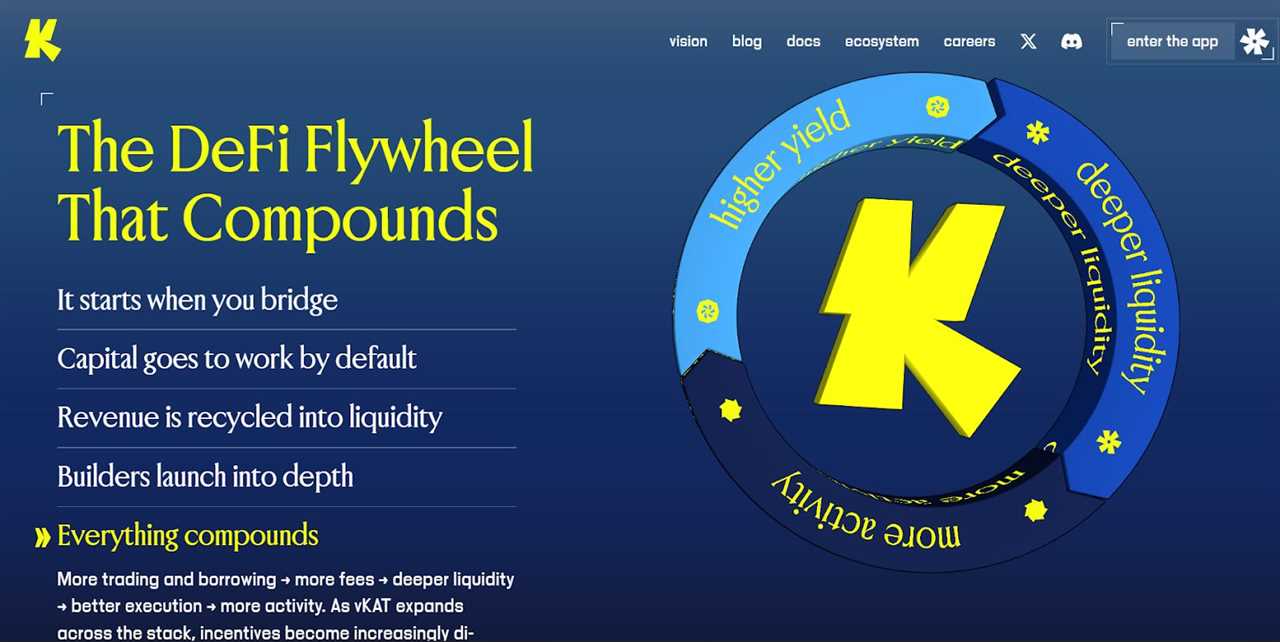
Katana works by consolidating key DeFi tools into a single, seamless network and using its own earnings to keep deeper markets healthy. When you trade Katana or lend it, the fees you pay help build stronger pools that benefit everyone.
A special bridge system brings assets from other chains easily, and a native stablecoin adds extra stability. Everything runs automatically, so users can focus on earning rather than worrying about scattered money or sudden dry-ups.
VaultBridge & Chain-Owned Liquidity
VaultBridge is Katana’s core system for managing deposits. It pools user funds into “vaults” that work efficiently across Layer-2 networks. On the other hand, chain-owned liquidity ensures liquidity is always available for trades and lending. This reduces inefficiencies and keeps fees predictable.
The Core App Stack: Sushi, Morpho & Vertex
Katana integrates with following key DeFi applications:
- SushiSwap: Enables fast decentralized trading with concentrated liquidity.
- Morpho: Optimizes lending and borrowing on Layer-2, boosting yields.
- Vertex: Provides cross-chain compatibility and token management for advanced users.
This stack ensures that Katana isn’t a standalone system but a connected ecosystem where liquidity flows seamlessly.
AUSD — Katana’s Native Stablecoin
AUSD is Katana’s stablecoin designed for Layer-2 DeFi. Users can trade, lend, or borrow AUSD without worrying about volatility. This makes the network more practical for everyday DeFi activities. Katana’s integration with VaultBridge and chain-owned liquidity ensures that AUSD is always available when needed.
What Is the KAT Token?
KAT is the native token of the Katana network. It serves several critical roles:
- Governance: KAT holders can vote on important decisions that affect the network. For example, they may vote on changes to reward programs, updates to liquidity incentives, or decisions about which chain upgrades the platform should support next.
- Incentives: Katana aims to reward users who contribute to the ecosystem. People who provide liquidity or participate in network activities can earn KAT as compensation for helping the platform remain active and efficient.
- Alignment: Because many users hold KAT, they benefit directly when the network grows and attracts more activity. This encourages developers and investors to support the platform long term rather than focusing only on short-term gains.
Together, these roles help ensure that the people who use and support Katana are also invested in its long-term success.
KAT Tokenomics
KAT has a fixed supply of 10 billion tokens, with its tokenomics structured as follows:
- Community airdrops (15%): Around 1.5 billion vKAT is allocated to community members, particularly Polygon (POL) stakers. These tokens are distributed in stages to encourage long-term participation.
- Liquidity mining (10%): About 1 billion KAT is reserved for users who provide liquidity on core applications such as Sushi and Morpho. These rewards are distributed through the apps themselves to incentivize trading, lending, and other activities that help the network grow.
- Core contributors (15.65%): Roughly 1.565 billion KAT is allocated to the team and early contributors who built the project. They will unlock gradually in four equal installments over 4 years after KAT becomes transferable.
- Ecosystem and community treasury (49.35%): Around 4.935 billion KAT is managed by the Katana Foundation to support ecosystem growth, developer grants, partnerships, and initiatives that strengthen chain-owned liquidity providers.
How to Earn With Katana
Katana offers multiple ways for users to earn rewards while supporting the network.
VaultBridge Deposits & vbTokens
When you bring assets through VaultBridge, you get vbTokens that represent your deposit and start earning right away. These tokens grow with the network’s activity, giving you a share of the steady rewards from chain-owned pools.
vKAT — Lock KAT to Earn Protocol Fees
Locking your KAT for vKAT lets you vote on where future rewards go and earn a portion of the fees from the pools you support. This incentivizes long-term holding and participation. The longer tokens remain locked, the stronger your voting influence can become within the ecosystem.
Liquidity Mining on Sushi & Morpho
Adding your coins to the main trading and lending pools on Sushi and Morpho earns you extra KAT rewards on top of regular trading fees. It is a simple way to put your assets to work and watch them grow while helping keep the markets healthy for everyone. You can track these rewards in real time in the Katana app dashboard for full visibility into your accrued earnings. After TGE, these earned tokens will become claimable and transferable.
Katana vs. Other DeFi Layer-2s
While many Layer-2 solutions compete for DeFi dominance, Katana’s focus on concentrated liquidity and VaultBridge gives it unique advantages.
Katana vs. Arbitrum
Arbitrum is a general-purpose Layer-2 protocol used by many DeFi projects. Here’s how it stacks against Katana:
| Feature | Katana | Arbitrum |
| Focus | DeFi only | General-purpose with an open ecosystem |
| Liquidity model | Chain-Owned, VaultBridge-funded | Protocol-level, fragmented across dApps |
| Core apps | Sushi, Morpho, Vertex | Hundreds of competing protocols |
| Token utility | Governance + fee-sharing via vKAT | Gas fee discounts + governance (ARB) |
Katana vs. Base
Base is optimized for Ethereum-native apps but doesn’t have Katana’s VaultBridge system.
| Feature | Katana | Base |
| Backing | Polygon Labs + GSR | Coinbase |
| Revenue recycling | 100% of sequencer fees back to CoL | Sequencer fees accrue to Coinbase |
| Native token | KAT | None |
| Stablecoin | AUSD | USDC |
| App philosophy | Opinionated – curated core stack | Open – any app can deploy |
KAT Price & Market Performance
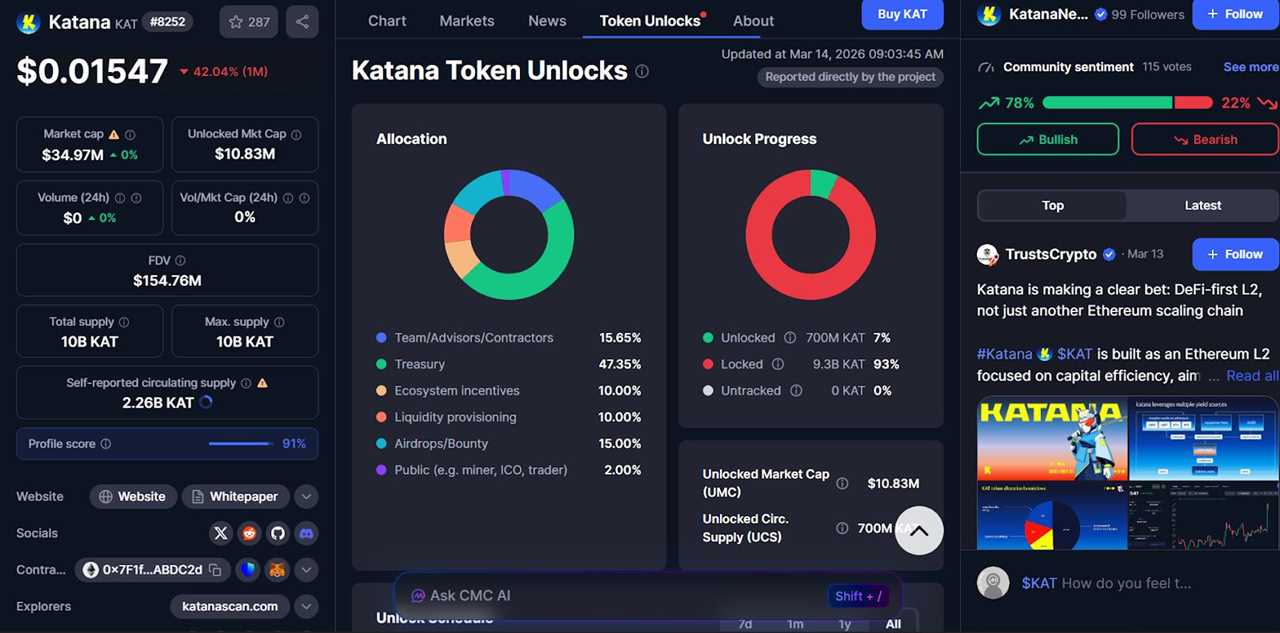
KAT has not yet reached its Token Generation Event (TGE) as of mid-March 2026, which is now targeted for on or before the end of March 2026. This means the token is not yet freely tradeable on the open market.
Despite this, market interest in Katana is strong. The mainnet launched in June 2025, attracting over $240 million in productive TVL before TGE. Several major crypto exchanges, including Binance, KuCoin, Phemex, and BingX, have announced KAT listings, signaling institutional confidence and broad distribution potential. On Binance, spot trading for KAT will begin on March 18, 2026, starting with KAT/USDT, KAT/USDC, and KAT/TRY pairs.
Price predictions remain speculative at this stage. Analysts suggest that, assuming steady adoption and TVL growth, KAT could trade between $0.015 and $0.04 by the end of 2026. Longer-term projections vary widely depending on adoption, revenue from VaultBridge and sequencer fees, and the proportion of KAT locked as vKAT, which reduces circulating supply and signals long-term holder conviction.
Key factors to monitor include TVL growth after TGE, which shows if users are deploying capital for real yield farming, and revenue from VaultBridge and sequencer fees, which determine whether the network’s real-yield model is performing as intended.
As of now, self-reported circulating supply stands at 2.26 billion KAT, with a total supply capped at 10 billion. Once TGE occurs, real market activity and liquidity will offer a clearer picture of KAT’s price trajectory.
Conclusion: Should You Invest in Katana (KAT)?
Katana presents a strong case for investors interested in Layer-2 DeFi solutions. Its focus on chain-owned liquidity and multiple earning opportunities makes the network practical and utility-driven. The KAT token allows you to participate in governance, stake for rewards, and influence the ecosystem’s growth, aligning user interests with network success.
With that in mind, KAT is still a new token with high volatility and market risks. It’s advisable to start cautiously, investing only what you can afford to lose while observing how the network and KAT token gain adoption.
FAQs
KAT is the main token of the Katana network that can be earned, airdropped, or bought. vKAT is created by locking KAT, giving governance rights and a share of protocol fees. It encourages long-term holding and participation in the network.
Katana may appeal to investors interested in Layer-2 DeFi and chain-owned liquidity. It has practical use cases and strong ecosystem support. Still, it’s worth noting that, like all crypto, it carries volatility and market risk, so do proper research before investing.
KAT will be available on major exchanges such as Binance, KuCoin, and Phemex after the TGE. To ensure you buy from a reputable exchange, always check official sources and verify the token’s address. It’s recommended to start with a small purchase to get familiar with the token.
The KAT airdrop for Polygon stakers is a 15% reward on the total supply, including liquid staking holders. It is distributed in four annual tranches to reduce selling pressure and encourage long-term participation. You can verify eligibility through the Katana app once tokens become transferable.
The biggest risks of investing in KAT are smart contract vulnerabilities due to its multi-protocol stack, supply dilution from POL staker airdrops, and potential liquidity stress during market downturns. Regulatory scrutiny and competition from established Layer-2 networks like Arbitrum and Base also pose challenges.
The post What Is Katana (KAT)? Polygon’s DeFi Chain Explained appeared first on NFT Evening.
Read MoreBy: Josephine Abiodun
Title: What Is Katana (KAT)? Polygon’s DeFi Chain Explained
Sourced From: nftevening.com/what-is-katana-kat/?utm_source=rss&utm_medium=rss&utm_campaign=what-is-katana-kat
Published Date: Sat, 14 Mar 2026 14:13:14 +0000
----------------------------