.png)
U.S. lawmakers and the White House said Friday that they have reached an “agreement in principle” regarding stablecoin yield mechanisms, according to Politico, marking a significant step toward breaking a months-long deadlock surrounding the CLARITY Act in Washington.
This compromise could unblock the legislative process for one of the most critical crypto bills in the U.S. today, while creating ripple effects across the digital asset market — including NFTs.
The Breakthrough in Washington
The agreement reached between Senators Thom Tillis, Angela Alsobrooks, and White House officials, first reported by Politico on March 20, is seen as a breakthrough after months of stalemate in the Senate since January.
According to Alsobrooks, both sides have “come a long way” in balancing the need to foster innovation with the protection of the traditional financial system, particularly against the risk of bank “deposit flight” if stablecoins were allowed to offer widespread interest.
The deal is not yet in its final version and still needs to be vetted with industry stakeholders, but it is considered a positive signal that parties have moved closer to a consensus on the very issue that has been the biggest bottleneck stalling the bill.
What’s in the Deal
The heart of the agreement centers on a long-controversial issue: whether crypto companies should be allowed to pay yield to stablecoin holders.
According to early reports, the current proposal mentions two key points:
- Restricting or banning passive yield — where users receive interest simply by holding the stablecoin.
- Allowing activity-based rewards, such as rewards for making payments or conducting transactions.
The goal of this approach is to mitigate the risk of “deposit flight” — where users abruptly withdraw funds from traditional banks to move into higher-yielding stablecoins.
However, the specific details of this mechanism have not yet been clarified, and the deal still requires further consultation with industry stakeholders before reaching a broad consensus.
The Core Clash Behind the Bill
The conflict over stablecoin yield has been the single largest knot stalling the CLARITY Act for months.
Traditional financial institutions fear that allowing stablecoins to pay interest will weaken the flow of funds within the banking system, as users are incentivized to move fiat currency into higher-yield digital assets.
Conversely, crypto companies argue that restricting yield will diminish the competitiveness of stablecoins, which play a central role in trading and payment activities within the crypto market.
This standoff has kept the bill stuck in the Senate Banking Committee since early January 2026, despite having previously passed the House of Representatives in 2025.
The new agreement, though incomplete, shows that both sides have begun to find a balance — a necessary condition for the bill to proceed through the legislative process.
The CLARITY Act’s Path Forward
The CLARITY Act is currently at a critical stage in the U.S. legislative process. The bill passed the House early in 2025, but stalled in the Senate as of January 2026, where more controversial issues — specifically stablecoin yield — must undergo more rigorous review and negotiation.
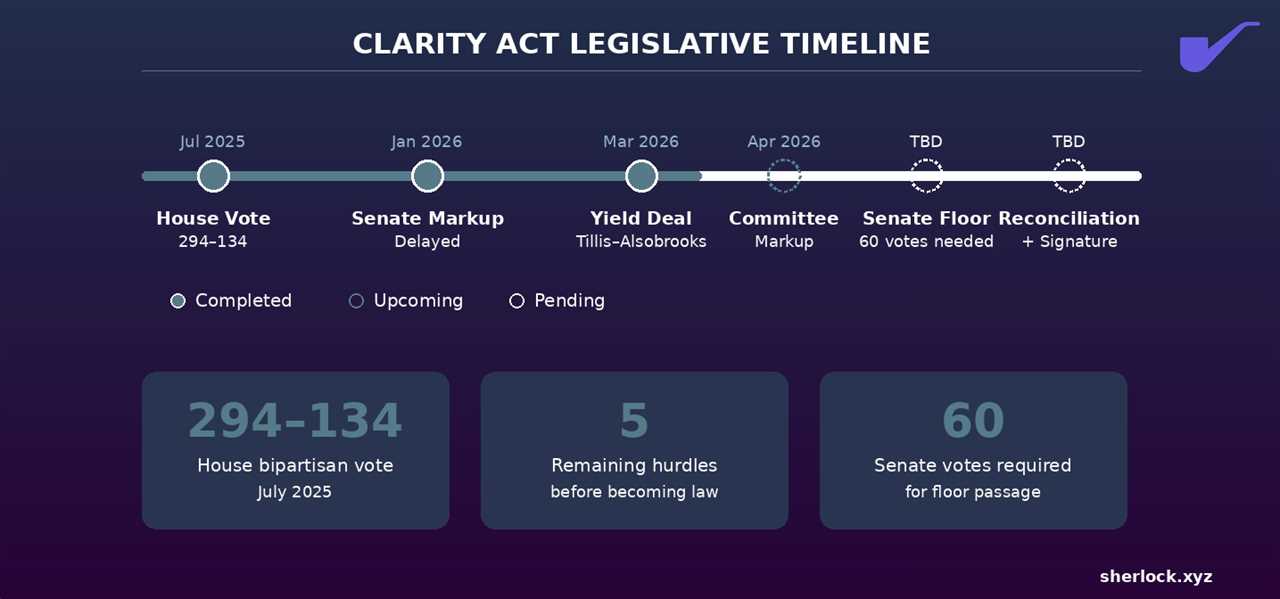
CLARITY Act legislative timeline. Source: Sherlock
The deal reached could help clear this path, paving the way for the next steps in the Congressional review process.
In April, the bill is likely to be brought forward for committee markup and amendments before it moves to a Senate vote, where it needs at least 60 votes to pass. If it clears this stage, the bill will enter a final reconciliation round before being presented to the President for signing.
Patrick Witt, a senior White House crypto policy advisor, described the deal as a “major milestone” in the bill’s progress.
Credit to @SenThomTillis and @Sen_Alsobrooks for bridging the partisan divide to tackle a difficult issue. More work to be done to close out this and other outstanding issues, but this is a major milestone toward passing the CLARITY Act. https://t.co/pA79lMxGvI
— Patrick Witt (@patrickjwitt) March 20, 2026
Nevertheless, the current agreement does not guarantee the bill’s passage. Many other issues remain to be resolved, including how to regulate DeFi and the division of oversight roles between regulatory agencies.
Implications for NFTs
Beyond its direct impact on stablecoins, the outcome of the bill could also affect how capital and liquidity function in other digital asset markets — including NFTs.
Currently, one of the biggest limitations of the NFT market is the lack of liquidity and incomplete financial infrastructure. NFT trading often relies on highly volatile assets such as Ethereum, while supportive financial tools, including lending or collateralization, remain limited.
In this context, stablecoins serve as a crucial settlement layer:
- Helping to reduce volatility in transactions.
- Providing a consistent unit of account.
- Facilitating more complex financial activities.
If the regulatory framework for stablecoins becomes clearer, it could:
- Improve the reliability of on-chain transactions.
- Attract more capital from traditional finance.
- Expand the potential for integrating NFTs into financial products.
While this impact may not be immediate, in the long term, a more clearly regulated stablecoin ecosystem could help lay the foundation for an NFT market that is more liquid and more closely integrated with the broader financial system.
Next Steps
In the short term, lawmakers will continue to work on refining the terms of the agreement and gathering input from industry stakeholders.
This process will be decisive in whether the CLARITY Act can pass through the next rounds of voting.
While the current agreement is seen as a significant step forward, the prospects for the bill’s passage still depend on whether lawmakers can reconcile the goals of fostering innovation and ensuring financial stability.
The result, if achieved, will not only shape the regulatory framework for stablecoins but could also have a broader impact on the liquidity structure of the digital asset market, including NFTs.
The post The Biggest Obstacle to the CLARITY Act May Be Falling — What the Stablecoin Deal Means for NFTs appeared first on NFT Evening.
Read MoreBy: NFTevening
Title: The Biggest Obstacle to the CLARITY Act May Be Falling — What the Stablecoin Deal Means for NFTs
Sourced From: nftevening.com/clarity-act-stablecoin-nft-impact/?utm_source=rss&utm_medium=rss&utm_campaign=clarity-act-stablecoin-nft-impact
Published Date: Wed, 01 Apr 2026 10:51:48 +0000
----------------------------
Did you miss our previous article...
https://trendingincrypto.com/nft-news/8-ai-trading-bot-tools-for-crypto-to-help-you-achieve-247-trading