.png)
The exploit of Drift Protocol, valued at approximately $285 million in the early hours of April 2, is shaking the Solana DeFi ecosystem, not only due to the scale of the damage but also because of its widespread impact.
On-chain data shows that the impact of the incident did not stop at a single protocol but has spread across multiple liquidity layers — from vaults and lending to liquidity provider pools. Amidst declining TVL and signs of capital migration, the question is whether this is merely a temporary shock or a sign of systemic risk.
Market Reaction: Liquidity Drops Amid Volatile Trading Activity
Data from DefiLlama shows that the TVL of the Solana DeFi ecosystem dropped significantly immediately after the hack occurred. Total TVL decreased from approximately $6.3 billion to around $5.3 billion in a short period, representing a decline of over 15%.
Solana TVL chart. Source: DeFiLlama
This decline reflects two factors: the direct withdrawal of assets from the involved protocols and defensive capital outflows from users in the short term. However, it should be noted that this is an abrupt drop, which is not yet sufficient to confirm a medium- or long-term downward trend.
Trading activity exhibited clear fluctuations following the announcement of the Drift Protocol hack. Trading volume on Solana DEXs reached nearly $3 billion on April 1, according to DefiLlama data, before decreasing significantly in the following days.
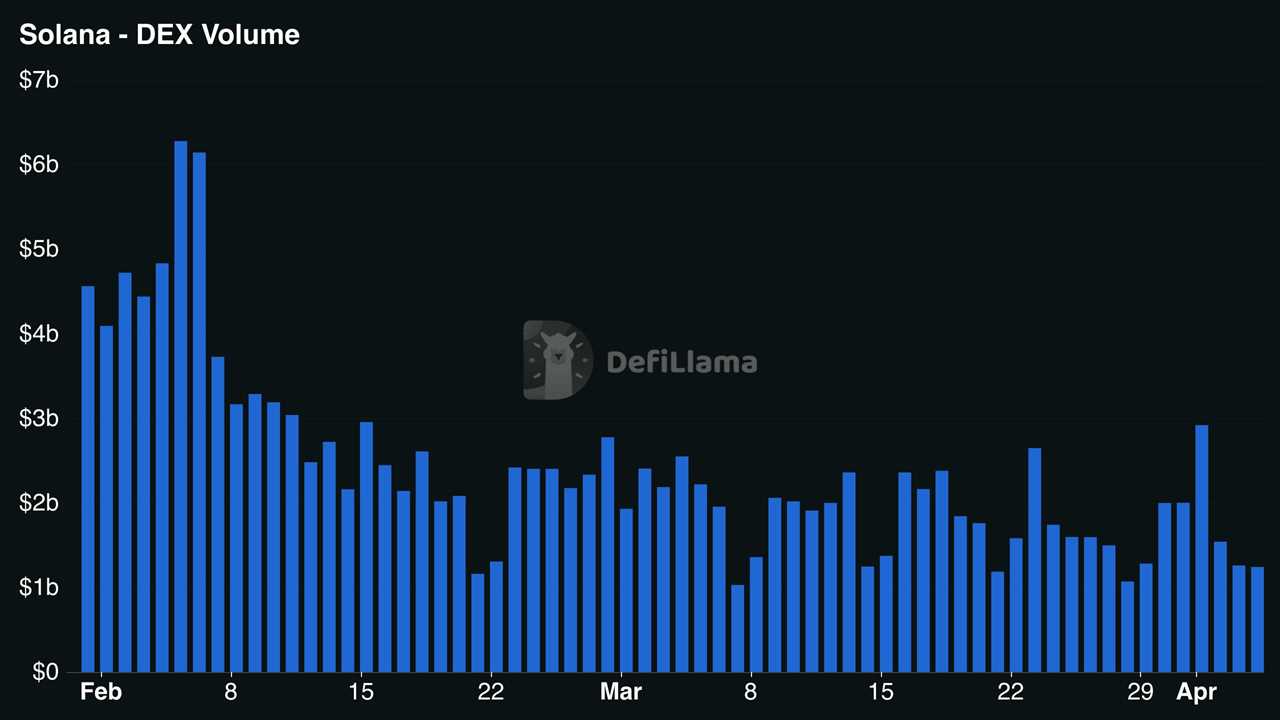
Solana DEX Volume chart. Source: DeFiLlama
The fact that liquidity decreased while trading activity only gradually weakened, rather than collapsing immediately, suggests that the ecosystem has not entered a state of liquidity “freeze” — the current shock has not yet escalated into a systemic liquidity crisis.
Cross-Protocol Impact & Contagion Risk
The impact of the hack has spread to various protocols within the Solana ecosystem to varying degrees. According to aggregated data from SolanaFloor, a series of projects have confirmed exposure to Drift Protocol, accompanied by emergency response measures.
🚨New: @DriftProtocol exposure tracker updated with more Solana projects confirming impact levels and the amount affected by the $285M exploit.
The tracker also includes actions taken and official statements from teams. pic.twitter.com/cFmzbYP7QY
— SolanaFloor (@SolanaFloor) April 3, 2026
Several cases show direct impacts on user assets. DeFi Carrot confirmed approximately $8.4 million in affected assets, with damages reaching up to 50% for the $CRT token, forcing the platform to pause minting and redeeming functions. Meanwhile, Reflect Money has frozen all minting and redeeming activities for its USDC+ and USDT+ products as a precautionary measure following the exploit.
Even protocols with limited exposure were forced to act. Ranger Finance stated it had paused deposits and withdrawals, even though its total exposure was only about $900,000 out of a total TVL of $14.6 million.
These reactions reflect a wide spectrum of states across the ecosystem, including:
- Paused certain functions
- Limited exposure to related assets
- Under assessment and auditing
The interdependence between protocols — especially in the DeFi composability — means that an incident at one point can spread through liquidity links and collateral, creating contagion risk.
However, as of now, there are no signs of a systemic collapse taking place. The majority of protocols remain operational, albeit in a more cautious state. This indicates that contagion risk remains potential rather than having erupted into a full-scale crisis.
Structural Weakness Exposed
According to information from Drift Protocol, the exploit did not stem from a bug in the smart contract but involved exploiting governance mechanisms through pre-signed transactions combined with multisig. Additionally, the use of “durable nonce” — a specific mechanism of Solana — is also believed to have played a role in the attacker’s process.
This approach demonstrates that the attacker did not just exploit a single bug but took advantage of multiple design layers within the system to gain control at the governance level. This is a more complex form of attack compared to traditional exploits and is harder to detect during the preparation phase.
Notably, components such as multisig, pre-signed transactions, and nonce mechanisms are not unique to a single protocol but are widely used in many DeFi designs, suggesting that risk may not be limited to an individual protocol but stems from how systems are designed and operated.
Can Solana DeFi Recover?
Following the incident, the recovery prospects of the Solana DeFi ecosystem have become a focal point for the market.
On a positive note, the platform still retains some supporting factors. Although TVL dropped sharply, it remains above the $5 billion mark, indicating that the scale of liquidity is still relatively large, while trading volume decreased after the exploit news spread.
Furthermore, history shows that the Solana ecosystem has recovered from major shocks before, including the Wormhole hack in February 2022, with damages of about $320 millions. At that time, the losses were backstopped by involved parties, helping to prevent a contagion effect and supporting the ecosystem’s recovery in subsequent stages.
However, negative factors cannot be ignored. A portion of the stolen assets has been moved to Ethereum, increasing the pressure of capital outflows from the ecosystem in the short term. More importantly, user confidence could be affected if risks related to governance and risk control mechanisms are not thoroughly addressed — one of the issues being widely discussed following the incident.
Additionally, the level of interdependence between protocols could make users more cautious, especially as the full scope of the incident’s impact has yet to be fully determined.
A Stress Test for Solana DeFi
The $285 million hack on April 2 is becoming a test for the Solana DeFi ecosystem, as its impact extends beyond a single protocol.
Instead of triggering an immediate collapse, this event is exposing how liquidity layers, governance mechanisms, and user behavior respond under pressure.
How the ecosystem adapts — from risk management and handling stolen assets to restoring confidence — will be the deciding factor in whether this is just a short-term shock or a sign of deeper weaknesses.
Currently, the market may be witnessing a true “stress test” for one of the largest DeFi ecosystems today.
The post Solana DeFi in Crisis After $285M Hack — Can the Ecosystem Recover? appeared first on NFT Evening.
Read MoreBy: NFTevening
Title: Solana DeFi in Crisis After $285M Hack — Can the Ecosystem Recover?
Sourced From: nftevening.com/solana-defi-285m-hack-ecosystem-recovery/?utm_source=rss&utm_medium=rss&utm_campaign=solana-defi-285m-hack-ecosystem-recovery
Published Date: Mon, 06 Apr 2026 08:55:19 +0000
----------------------------
Did you miss our previous article...
https://trendingincrypto.com/nft-news/leading-8-secure-crypto-cloud-mining-platforms-mine-bitcoin-and-dogecoin