.png)
Grayscale has made a notable move on the Ethereum (ETH) network by staking approximately 83,200 ETH (equivalent to nearly $184 million) through the Ethereum Mini Trust on April 9th. According to on-chain data aggregated by Lookonchain, the transactions were executed in multiple batches and transferred to staking addresses via Coinbase’s platform.
This move does not merely reflect capital allocation; it shows how large financial institutions are beginning to “operationalize” crypto assets — shifting from passive holding strategies to deploying staking to generate yield, reflecting a change in how crypto assets are approached at the institutional level.
What Happened
On-chain data shows that Grayscale split the ETH into multiple transactions of approximately 3,200 ETH per batch before sending them to staking contracts, with the total value reaching about 83,200 ETH (~$184 million) at current market prices.
Grayscale (Ethereum Mini Trust) staked 83,200 $ETH($184M) again 3 hours ago.https://t.co/OcQGQe8US6 pic.twitter.com/5tp14oowCE
— Lookonchain (@lookonchain) April 10, 2026
The transactions were carried out through Coinbase’s staking system, indicating that Grayscale is utilizing institutional-grade staking infrastructure rather than operating its own validators.
With this new transaction, Grayscale has raised its staking level to nearly 70% of its total ETH holdings (approximately 868,856 ETH). The total amount of ETH deployed for staking continues to rise, showing that this is a core part of the fund’s capital allocation strategy rather than a short-term decision.
This move comes during a period of low volatility in the Ethereum market, suggesting the primary goal is not short-term trading, but optimizing long-term cash flow.
Strategy Behind the Move
Grayscale’s staking move reflects a clear strategy: transitioning ETH from a passive holding into a yield-bearing asset.
Grayscale Ethereum Staking Mini ETF. Source: Grayscale
A staking ratio of nearly 70% indicates that this is no longer an experimental activity, but a systematic capital deployment direction. The fund’s net staking yield is currently around 2.51%, relatively close to the overall ETH network benchmark (approximately 2.74%).
This suggests that Grayscale is not seeking to “beat the market” but is implementing a capital optimization strategy according to institutional standards — similar to how traditional funds seek yield from bonds or fixed-income assets.
In other words, ETH is no longer just a speculative asset. It is gradually being treated as a yield-bearing asset.
Ethereum’s Staking Landscape
Grayscale’s staking move comes as staking activity on the Ethereum network has reached a massive scale. The total amount of ETH currently being staked has reached approximately 38.9 million ETH, with over 1.2 million active validators worldwide, according to statistics from MacroMicro.
This scale shows that Ethereum has evolved into a sustainable staking ecosystem characterized by high decentralization and wide participation. Therefore, institutions like Grayscale no longer play the role of “pioneers” but are rather participating in an infrastructure that has been established and is operating stably for some time.
The maturity of the network helps yields become more stable and predictable — a crucial factor for institutional capital. These are the key elements that make staking attractive to institutional funds, which prioritize stability over exponential returns.
Diverging Institutional Strategies
While Grayscale is ramping up staking, ETF data shows a different picture of institutional capital flows.
According to Coinglass data, BlackRock recorded a significant inflow, equivalent to about 41,500 ETH, while Fidelity saw an outflow of about 9,500 ETH. Grayscale products exhibited mixed capital flows, reflecting portfolio-wide adjustments.
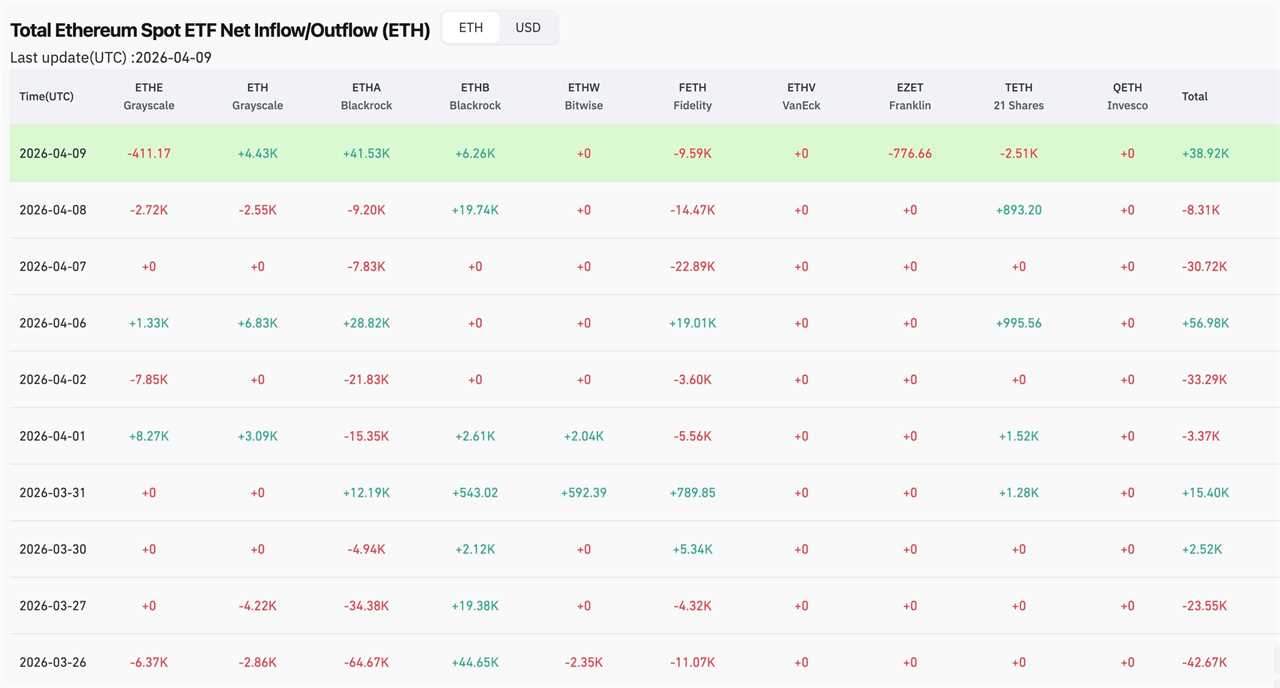
Ethereum spot ETF flow in the past 10-day. Source: Coinglass
This divergence shows that institutions are no longer following a single common strategy. Some focus on increasing exposure to ETH through ETFs, while others are beginning to seek ways to optimize yield from their holdings.
The recent move further demonstrates that Grayscale is expanding its approach, moving beyond mere exposure toward optimizing value from the assets held.
A Shift in How Institutions Use Crypto
The increase in Grayscale’s staking occurs as the crypto regulatory framework in the US is gradually becoming clearer. Proposals like the CLARITY Act could provide a foundation for a clearer definition of rewarded staking activities, thereby influencing how institutions deploy digital assets.
Increasing the staking ratio not only helps generate additional yield but also reduces the circulating supply of ETH, as assets are locked within the validator system. If this trend continues, the market supply structure may shift toward becoming tighter, even if the impact on price is not immediate.
Another aspect is that the ability to generate yield also helps Ethereum differentiate itself from Bitcoin in the eyes of institutional investors. As capital flows increasingly emphasize asset utilization efficiency, platforms that can both store value and generate income may attract greater interest.
From Ownership to Utilization
Grayscale’s $184 million ETH stake move is not simply a large transaction. It reflects a deeper shift in how institutions approach crypto assets.
Instead of just holding, institutions are starting to optimize assets, seeking yield, and leveraging blockchain infrastructure as a financial system.
If this trend continues, staking could become an indispensable part of the strategy for traditional institutions.
The post Grayscale Stakes $184 Million in ETH, Signaling a Strategic Shift Toward Yield appeared first on NFT Evening.
Read MoreBy: NFTevening
Title: Grayscale Stakes $184 Million in ETH, Signaling a Strategic Shift Toward Yield
Sourced From: nftevening.com/grayscale-stakes-184m-ethereum-yield-strategy/?utm_source=rss&utm_medium=rss&utm_campaign=grayscale-stakes-184m-ethereum-yield-strategy
Published Date: Sun, 12 Apr 2026 15:29:29 +0000
----------------------------